February 21, 2024 | By: Karine K. Sardagna
Share
Every day, new technologies emerge to refine processes and bring better results to business management, and the logistics sector is no exception.
A quick search on the Internet can confirm the existence of a growing number of applications and systems focused on optimizing the loading and unloading processes of products and goods.
Given this scenario, small companies – and also those that already hold a representative market share – have increasingly invested in management systems, including those for the delivery receiving area.
These companies have already realized that greater agility in this area directly impacts cost reduction. In turn, cost reduction occurs because information is centralized and can be accessed at any time, avoiding communication failures and misunderstandings about how many and which deliveries will be made, when, and who will perform them.
The organization of information also allows managers and professionals in the area to monitor the entire lifecycle of their deliveries. Delivery delays and stock-outs are avoided, in addition to all kinds of rework before, during, and after loads and unloads are actually performed.
Furthermore, process automation has played a key role in increasing productivity – and quality! On one hand, the delivery receiving area has experienced a considerable reduction in operational and repetitive work. On the other hand, this same area has had the opportunity to dedicate more time to more strategic aspects that add real value to the business.
Delivery receiving management systems naturally have some aspects in common, as well as additional features and differentiators that may – or may not – be important for your business.
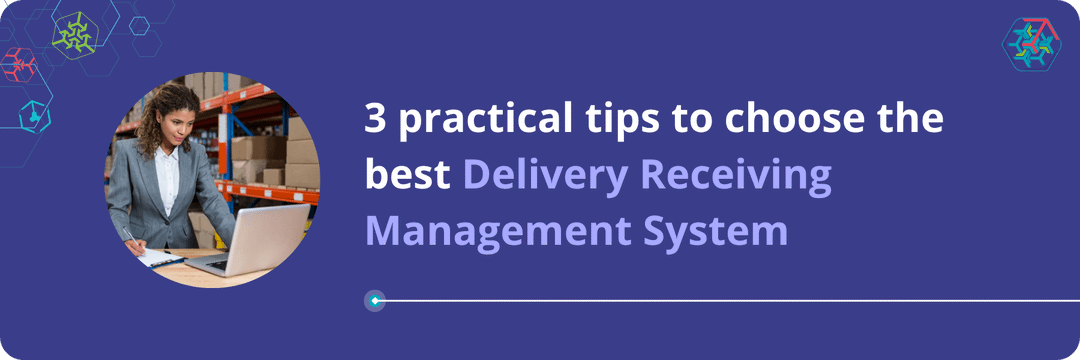
See below for 3 practical tips for choosing the best Delivery Receiving Management System:
Before choosing a delivery receiving management system, you need to know exactly what your greatest need is.
If truck queues are a problem, focus on a system that can schedule appointments with your suppliers quickly, easily, and without complications. If, in turn, it is the invoices that generate bottlenecks throughout the loading and unloading process, look for a system that addresses this situation.
Truck queues, freight surcharges, stock-outs, insufficient and inaccurate information, lack of integration between logistics, commercial, and fiscal sectors, operational idleness, rework. What is your biggest 'pain point'?
While meeting your main need – the one that represents the biggest 'pain point' in the delivery receiving area – think about other day-to-day situations that also need to be optimized.
Have you ever stopped to analyze the time your team takes to confirm, reschedule, or cancel a load/unload? And if, by chance, the invoice does not match the order, what effort will be required to resolve this problem?
Make a list of difficulties or problems faced by the team responsible for your company's loading and unloading. Grade the items by assigning them degrees of importance. Analyze the impact that each of these items has on your business's sales and profits. Have you realized, for example, that many customers who look for your company stop buying because products are frequently out of stock? Have you considered that this problem can be solved through fixed scheduling with your suppliers?
When choosing a Delivery Receiving Management System, pay attention to functionalities that are sold as great features, but which in practice will not be useful for your business.
Remember those sneakers with round shock absorbers that were fitted under the insole? The idea of being able to change the shock absorbers according to the type of terrain seemed incredible. But, in day-to-day life, who actually remembered and, more importantly, was motivated to change them before starting a walk or run?
How many people looking for an orange juicer were seduced by a 3-in-1 – food processor, blender, and juicer – and its countless accessories for slicing, chopping, grating, emulsifying, squeezing, and blending? In two or three attempts at use, the simple and easy-to-make orange juice turned into a complex pile of parts to wash.
Reflect on whether the resources available in the system are essentially important for your company. Analyze the costs of numerous functionalities that, in day-to-day life, will be little or perhaps never even used. Consider to what extent additional features will help – or not – your delivery receiving process. [Author: C.I.]
We at Tempo Certo know that every business is unique and that the ideal technology is the one that meets your company's specific needs. Our system is developed so that you and your team can transform the delivery receiving process into a strategic differential.
We focus on improving operational aspects, but we look far beyond your company's daily processes. We understand that our role is to ensure you spend less time on operational issues in the delivery receiving area and, instead, concentrate your efforts on the core business, the reason for your business, and the soul of your company."
Share
Contents
See also
Complete the form and a member of our team will be in touch shortly.
We respect your privacy and will never share your information with third parties.
 Monday to Friday - 9:00am to 5:30pm
Tempo Certo Soluções em Softwares Ltda | © All rights reserved
Made by: