April 10, 2026 | By: Letícia Zen
Share
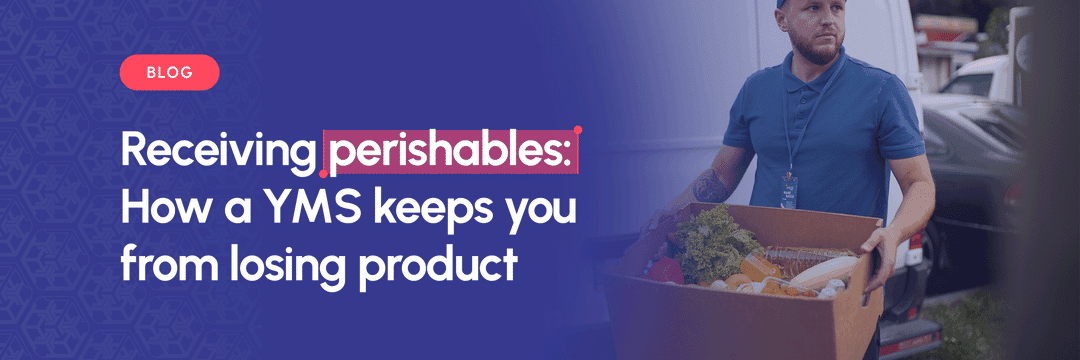
When it comes to the logistics of perishable goods—such as food, beverages, refrigerated products, or pharmaceuticals—delivery time is a critical operational metric. After all, delivery delays, dock queues, and idling trucks are situations that commonly result in financial loss and reduced product availability on shelves.
According to KPMG, retail losses in Brazil alone reached R$ 34 billion in 2023, with perishable products being the most wasted. In supermarkets, perishables can represent inventory shrinkage of up to 40%.
This means that delays in loading or unloading result in high financial costs, product waste, and even impacts on item availability. Therefore, organizing the logistical flow within distribution centers and industrial plants is essential.
In this post, we highlight how YMS plays a strategic role in yard management, especially for receiving perishable loads. Check it out.
Unlike other types of merchandise, perishable products require greater control over time, temperature, and handling conditions. Any bottleneck in the yard, such as truck queues or delays in dock service, can compromise cargo quality.
In addition to increasing logistical costs, these bottlenecks raise the risk of product loss and reduce the efficiency of the entire supply chain.
YMS is a system developed to manage and optimize operations that occur in the logistics yard, from the truck's arrival to its departure after loading or unloading. With the support of this technology, companies gain real-time control over vehicle movement, dock occupancy, and dwell time in the yard.
In practice, this allows for organizing the logistical flow and reducing bottlenecks that directly impact the quality of perishable goods. Visibility allows for real-time adjustments at the docks, sectoring perishable orders, and speeding up loading and unloading.
Adopting a yard management system brings significant gains to operations working with time-sensitive products. Here are the main ones:
With dock scheduling, carriers have defined arrival times. This reduces truck queues and avoids delays that could compromise cargo quality.
Vehicle flow control allows trucks to be quickly directed to available docks, decreasing the time spent in the yard.
Managers can monitor the status of each vehicle, identifying bottlenecks and making faster decisions to keep the operation moving.
With centralized information, areas such as the gatehouse, logistics, and warehousing work more integratedly.
Logging arrival, service, and departure times creates an operational history that helps continuously improve logistical processes.
In perishable operations, logistical efficiency goes beyond productivity; it becomes a way to guarantee quality and reduce waste. By organizing truck flow, improving dock usage, and increasing operational visibility, YMS transforms the yard into a strategic point in the logistics chain.
Thus, companies can ensure that goods reach their destination at the right time (Tempo Certo), preserving quality, reducing losses, and increasing the efficiency of the entire operation.
Want to know more about efficient control and management of perishable loads? Get in touch and speak with our experts!
Share
Contents
See also
Complete the form and a member of our team will be in touch shortly.
We respect your privacy and will never share your information with third parties.
 Monday to Friday - 9:00am to 5:30pm
Tempo Certo Soluções em Softwares Ltda | © All rights reserved
Made by: